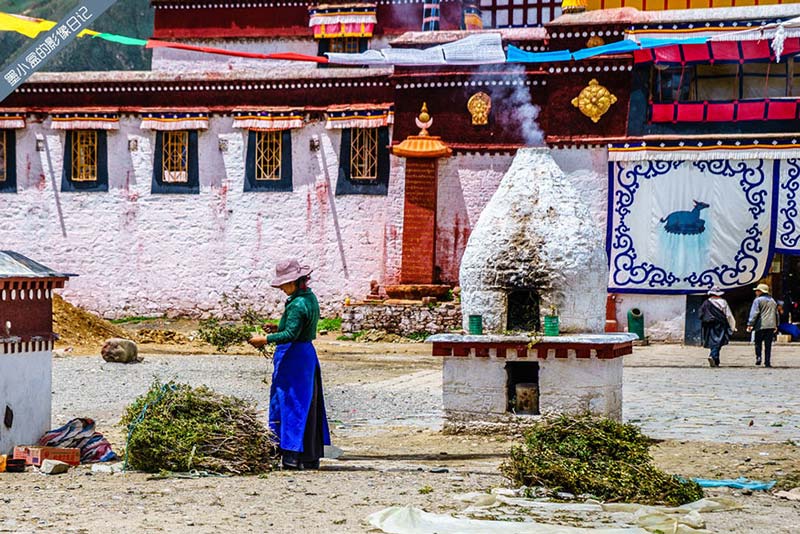
Samye Monastery is a grand complex with a unique layout. Upon first entering the monastery, one may be bewildered by the densely packed halls and pagodas. However, once you understand the meaning behind each building and its role in the overall layout of the monastery, you will surely be captivated and impressed by this magnificent architectural ensemble.

Samye Monastery's architecture is said to be modeled after the Odandapuri Monastery built by the ancient Brahmanical dynasty in Magadha, India. The entire monastery's layout follows the Buddhist concept of the universe: at its center is Mount Meru, the center of the world, represented by a three-story "Uyu Hall" in Tibetan, Han, and Indian styles. To the north and south of the Uyu Hall are two more halls, representing the sun and moon, symbolizing the sun and moon in the universe. At the four corners of the Uyu Hall are four stupas of red, white, green, and black, representing the Four Heavenly Kings. Around the main hall are four large halls and eight smaller halls, representing the four continents and eight subcontinents of the four oceans. The monastery complex is surrounded by a circular wall, symbolizing the Iron Mountain surrounding the world. The overall layout of the monastery also bears some resemblance to the mandala (or mandala) of Tantric Buddhism.
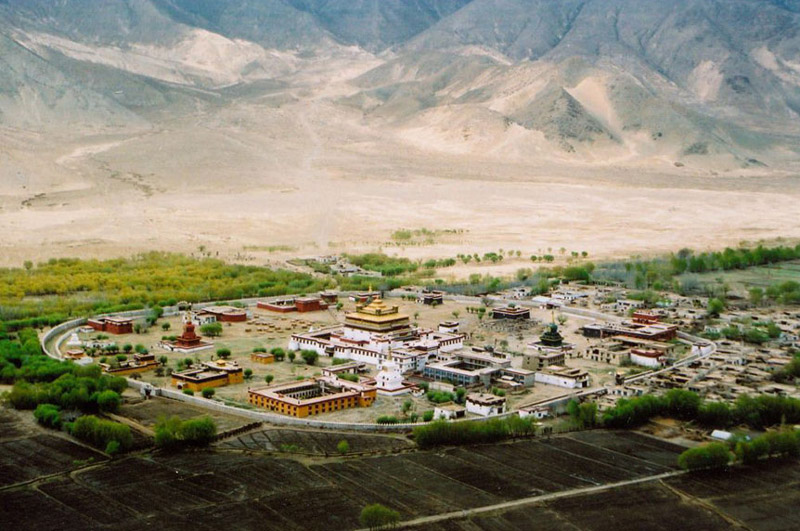
The best place to appreciate the exquisite layout of the entire temple is from the top floor of the Uyu Hall. From this vantage point, one can see the four continents of Jiangbei Lin, Ayabaluo Lin, Qiangbalin, and Sangye Lin in the four cardinal directions, surrounded by the eight smaller continents, the Sun and Moon Hall, and the four pagodas (white, black, green, and red). The ingenious design and clever layout will leave you in awe. The only minor flaw is the newly built inn to the right of the main entrance of the hall. Its size is similar to the Hall of the Four Continents, and it clashes somewhat with the overall architectural style, appearing rather out of place. However, this certainly provides convenience for travelers like ourselves. Furthermore, in this microcosm-like complex representing the vast universe, the presence of a building "belonging" to travelers seems quite symbolic to me; perhaps it represents the ultimate convergence of travelers and practitioners.
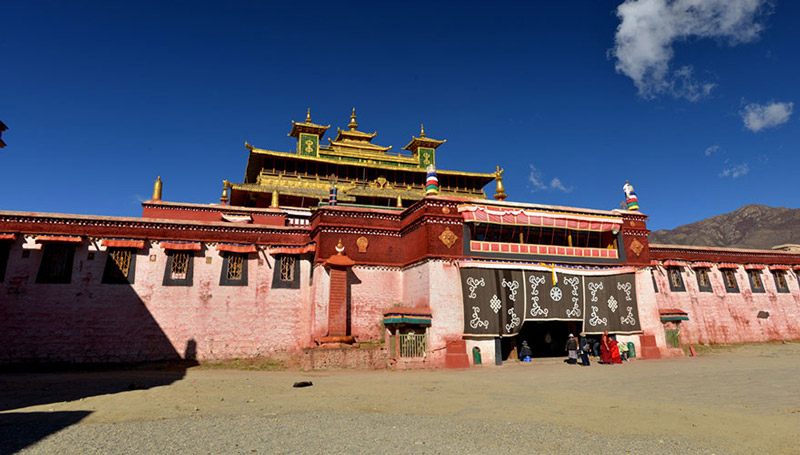
The Uyu Hall is the main hall of Samye Monastery, located in the center of the entire monastery. It faces roughly east and has three stories. The bottom story is in Tibetan style, the middle story is in Han style, and the top story is in Indian style. Samye Monastery's other name, "Three Styles Monastery," comes from this.